


Kiana Zamani remembers the day she left Iran better than she remembers her arrival in America.
“I remember the last day I was there, my goodbye party,” Zamani said.
Her friends threw her a pool party the day before she left for America. She felt happy that they thought to throw her a party, though she knew she would miss them. She is still close to these friends and talks to them often.
At the time, Zamani was 15 years old. Now she is a 16-year-old junior at Portsmouth High School. When she was first told she was moving to America, she felt indifferent. All she knew about the country was from stories of others, and she didn’t know what her life here would look like, but she wasn’t scared.
Zamani is one of many immigrant students in our community, and her experience reflects that of others. Across the U.S., immigration continues to shape everyday lives for millions of people.
According to USAFacts, there were 2.8 million new arrivals of immigrants in 2024. The Pew Research Center states that in January 2025, 53.3 million immigrants lived in the United States. Despite the large number of immigrants in America, misconceptions about them are more common than accurate information.
If you look at the news, immigration is everywhere, yet it’s rarely explained how it works or why people immigrate in the first place.
Branden Ladebush is an immigration attorney who works at Ladebush Legal in Dover, NH. He said that the general public doesn’t understand how complex the process is. He often hears people saying that immigrants facing deportation have had multiple years and chances to become citizens, which isn’t always the case.
Ladebush also said that one of the hardest steps of immigration is “finding some way to stay in the United States legally.” Coming to the U.S. doesn’t guarantee someone can stay long-term. The procedure of becoming a permanent resident is much longer and harder than people realize.
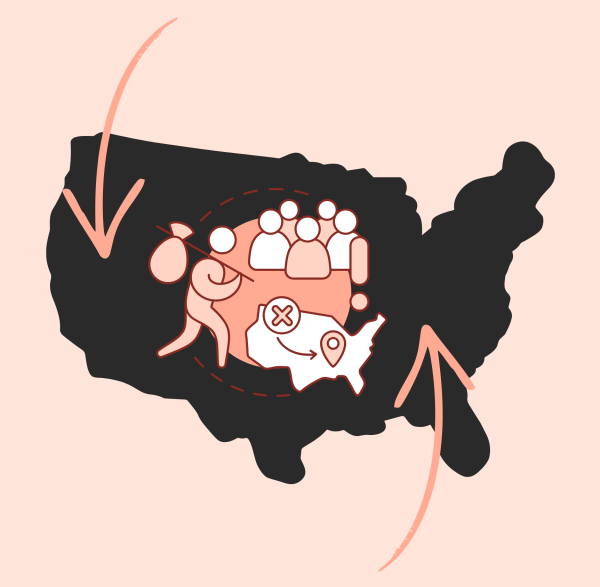
How to immigrate to the U.S.
There are two types of visas a person can get: an immigrant visa and a non-immigrant visa. Non-immigrant visas are temporary for things like tourism, business, and education. Immigrant visas are for people who plan to stay in America permanently, usually people who have family here.
Ladebush also explained that immigrants arriving at the southern border often come to apply for asylum when running from danger in their home country. To apply for asylum, you need to have “credible fear,” and you will often have to pursue your defense in court.
The U.S. Department of State organizes applying for a visa into 12 steps. These steps are not only for the applicant but also for a person (usually a family member or an employer) to sponsor the visa application, called the petitioner.
The first step is to submit a petition, either an I-130 (Petition for Alien Relative) or an I-140 (Petition for Alien Worker).
Then your case is transferred to the National Visa Center (NVC) to be processed. The number of visas that can be issued is limited per year in certain categories, often by country.
Next, two additional fees must be paid. The Immigrant Visa Application Processing Fee and the Affidavit of Support Fee. These can be paid by either the applicant or the petitioner.
Then the petitioner must fill out the Affidavit of Support form (I-864). This is where the petitioner accepts full financial responsibility for the applicant. If the petitioner’s income is not sufficient, then another sponsor could do the form on the applicant’s behalf.
The next few steps are additional documents, mostly completed by the applicant, though some require both the applicant and the petitioner. These documents include financial documents, civil documents, scanned documents, and Form DS-260 (online application form).
The visa interview is the next step, and this decides whether your visa is approved or denied.
As of 2026, the citizenship procedure takes about 5.5 to 6.1 months, which is the lowest it’s been since 2016. You have to wait five years after you get a green card to actually start applying for citizenship, and the green card process itself is complicated.
The length of time it takes to get a green card is dependent on what type of visa you have, when you apply, and what country you are immigrating from. Each year, there is only a certain number of green cards given out, with each country not being able to receive more than 7%.
If you are from a country with a lot more immigrants, then you might be stuck waiting for a green card for over a decade. For some, the money associated with these procedures is also too much.
Common Struggles
Terry Farish is an award-winning author of immigrant stories, and teaches English to adults at Exeter Adult Education. She explained how the hardest thing for immigrants that she has observed is learning English.
She said that not knowing the language when you first come to America often makes immigrants “feel held back.” She has seen firsthand the struggle of learning a new language.
One of her students found a job doing laundry at a nursing home, but as his English skills got better, he was asked to have a higher position at the nursing home.
For many immigrants, learning English can significantly increase their chances of getting a higher income, and it even helps with going through the permanent resident application, since interviews are a prominent part of it.
Farish also explained how “a lot of people have opinions, not knowledge,” about immigration. She said that people don’t seem to comprehend the struggles that immigrants face both during and after the process.
Another common struggle for immigrants is financial matters, specifically with finding housing that is at an appropriate cost. In the Seacoast region, the cost of housing is high. As of February 2026, the median home sale price is over 1 million dollars in the Seacoast region.
Every immigrant has a different story. Some have stories similar to Zamani’s, while others might have one that’s completely different. Ladebush described it by saying, “I don’t think there is one standard experience, and that’s the beauty of the immigration process.”
At Portsmouth High School
PHS has an English for Speakers of Other Languages (ESOL) program that teaches non-native English speakers English.
Portsmouth School District Superintendent Dr. Zachary McLaughlin shared that funding for this program is both provided by the state and is dependent on how many students are in the program.
Students take a state-mandated assessment called ACCESS, which measures how proficient they are in English. They can use this assessment to test out of the class.
According to Superintendent McLaughlin, when an immigrant student joins the school in the middle of the year, the school works to best support the student, ensuring there are no gaps in their education. This is done through a collaborative effort from the students’ teachers and the ESOL teacher in the building.
The student is tested in their English language ability, and if needed, they will be put in the ESOL program, where they can get guidance as needed.
The ESOL teacher plays the largest role in helping the immigrant students. They help connect the students to schools and clubs, and help with any struggles in classes.
Betsy Kelleher-Horne, the PHS ESOL teacher, said a common misconception around non-native speakers is that they are considered less capable due to possible struggles with communication.
“Students often say they feel dumb and they don’t know how to communicate their ideas because of their language level. Usually, these students have a lot to say, but obviously, if you don’t have the words for the language, it is difficult to get it out,” Kelleher-Horne said.
Kelleher-Horne also explained how learning English can provide students with the confidence to participate in other classes, since it is easier to communicate confidently. She shared that while there is no specific time length it takes for students to be able to converse in English, students are usually able to do so after about a year.
The PHS immigrant population might be small, but its role in the community is significant. Kelleher noted that, “they bring hard work and perseverance, as well as a unique respect for the school system in general.”
ESOL is the only immigrant-specific program in the district, but it is able to support many different immigrant students.
“While we don’t have a large number of programs specifically designed for this purpose, Portsmouth is a welcoming community where school communities genuinely come together to support new students in many meaningful ways,” Superintendent McLaughlin said.





![Piscataqua River Bridge [I-95] taken, March 24, 2026, in South Eliot, Maine.](https://phspaperclip.net/wp-content/uploads/2026/04/A5094948-30A6-485A-AF79-7DE27D521913_1_105_c.jpeg)