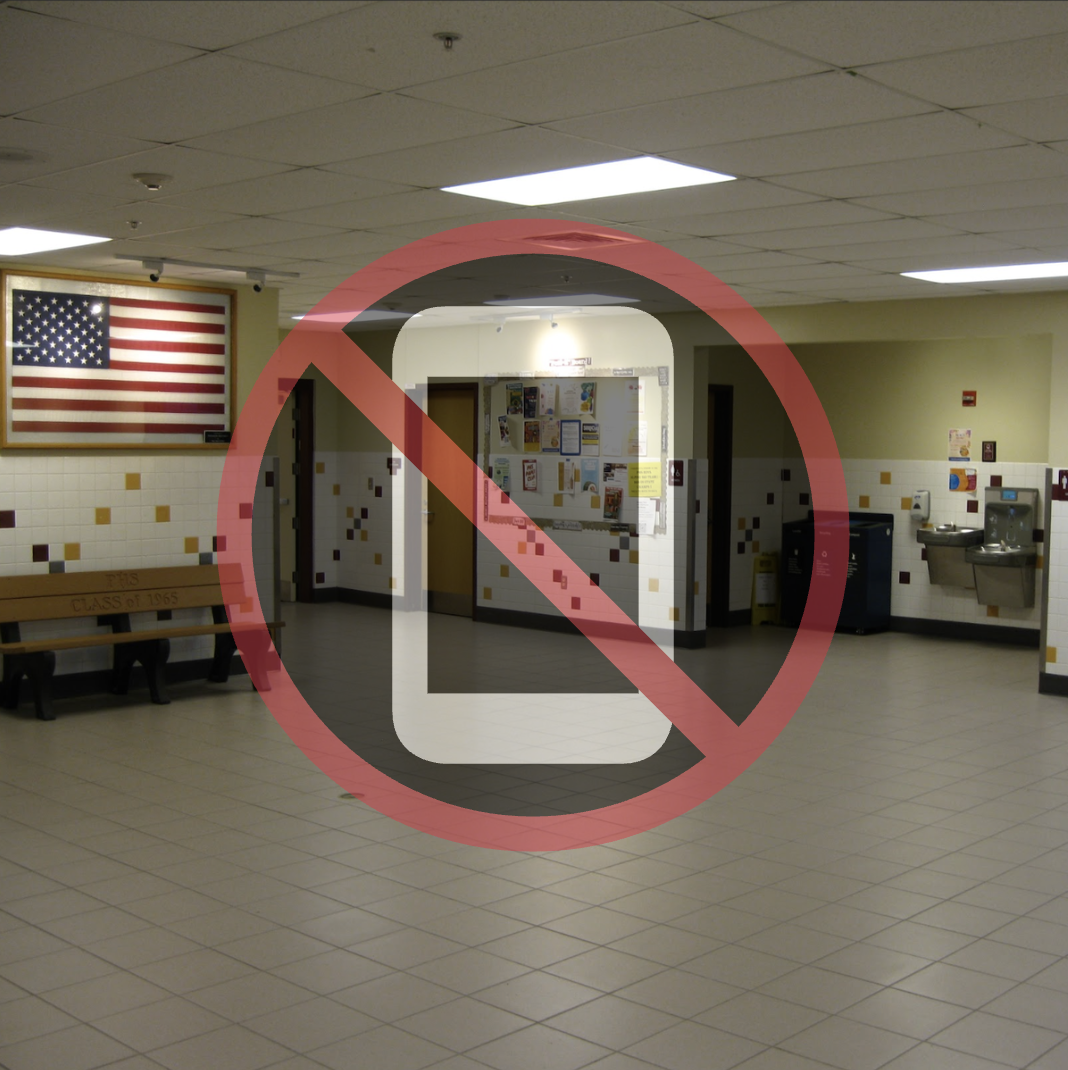
On any given morning at Portsmouth High School, one used to notice students drifting through the hallways with their heads glued to glowing screens. Thumbs were scrolling, necks were bent, and conversation and eye contact were limited.
Now, that “screenager” atmosphere has changed.
On July 1, 2025, New Hampshire Public Schools implemented a statewide “bell-to-bell” cell phone ban, prohibiting students from using personal electronic devices throughout the entire school day.
Governor Kelly Ayotte has emphasized that minimizing phone use in classes and during school hours is “essential to fostering deeper engagement, improving academic performance, and restoring classrooms as spaces dedicated to learning, collaboration, and student well-being.”
Now, seven months into the policy, students and faculty are still adjusting, but many say the changes are already reshaping the school’s social and academic environment in several ways.
For many teachers, the impact felt immediate.
Social studies teacher Maya Glos says [the phone policy] “is wonderful, but should be stronger.”
She feels the way things are going right now is “inequitable,” because some students have access to personal MacBooks that can connect to their phones. Students are still finding ways to work around the ban, and Glos states that this is not fair to students or teachers.
“I definitely think it should continue,” she comments. “It’s been very helpful to the teachers, and I’ve noticed a huge difference in the students, but there are some flaws that we’re still facing.”
Katie Reis, the drama teacher at Portsmouth High School, has similar views with a slightly different take on the issue.
“I think it’s been great because students don’t need their phones in school. I agree [with the students] that you guys should have it during break times, but it would be impossible to control. Once students have them, they have them. It’s all or nothing,” said Reis.
Reis also comments that she is “surprised to see that it [the policy] has lasted this long.”
She then presented the idea that the policy is “helping students learn the difference between phone culture at home and phones in a work environment.”
“When you have a job after High School or College, you can’t just be scrolling on your phone or constantly have it out. You need to know how to be professional and use your devices responsibly, and I think this policy has helped a lot with career readiness,” said Reis.
Among students, reactions have been mixed but are changing as the year goes on. Miah Bernier, a senior at PHS, says that she thinks the student body was “definitely more hostile to it at first, but people have warmed up to it throughout the year.”
Bernier also comments that she thinks people’s reactions have been excessive.
“I think people are overreacting. You don’t need your phone at school,” said Bernier.
She also addressed a common argument from our upperclassmen, adding, “people are always saying ‘oh but I’m 18, I should be able to have it,’ but you don’t need it. School is supposed to be learning.”
From her perspective, the policy has had practical benefits. “It’s easier for teachers, and the day just goes more smoothly,” Bernier added. “People are more connected and focused.”
Despite these academic enhancements, the biggest impact of the new ban may not be academic, but social.
“People aren’t scrolling on their phones at lunch, which means people are having genuine conversations and catching up rather than getting lost on social media,” said Lila Wasserman, a sophomore at PHS.
Eva Lyng, a junior at Portsmouth High School, has a pretty neutral take on the policy.
Lyng “doesn’t mind [the policy] but it makes coordinating hard sometimes if you’re trying to go off campus for lunch. Seeing if someone wants to go with you or making plans after school can be hard, and I don’t think phones were the biggest issue in passing periods, but I do agree that it [the ban] helps people be more social.”
“[Juniors] are definitely in a unique position because we will have two years with the phones and two years with the ban, so we really have a 50/50 perspective. I’m kinda neutral about it [the policy] to be honest,” said Lyng.
A freshman’s take on the policy brings a different perspective.
“I think I have a different experience surrounding the phone policy than some of the upperclassmen, because I wasn’t here before it was implemented,” said Claire Sargent, a PHS freshman. “I don’t mind not being able to use our phones in school and I think it can be good in terms of people focusing on work and things like that.”
She also recognizes that it can “make it harder to communicate with friends from other classes during the day, but overall, it is better than having people on their phones during class and not learning as much.”
She closes by commenting “It might be easier for [freshman] because we won’t have [phones] for all four years, so it’s all we will ever know. But for [the seniors] and the juniors, I can see how it could be harder to adjust to.”
And adjusting is exactly what we’ve started to do.
When asked about the phone policy, assistant principal Mr. Grossman stated: “It has definitely changed the student body dynamically, and I’ve noticed more eye contact and students talking more with each other.”
Grossman also commented that he saw more students meeting to talk and make plans in breakout spaces instead of being on their phones to communicate.
“Students are more ‘locked in, ‘ so to speak,” said Grossman.
Grossman says the policy will “definitely continue in some way, but there could be a few changes in the future. We meet every summer to discuss what’s working and what’s not, so there is always the possibility of change, but as of now, nothing is in the works in terms of modifications.”