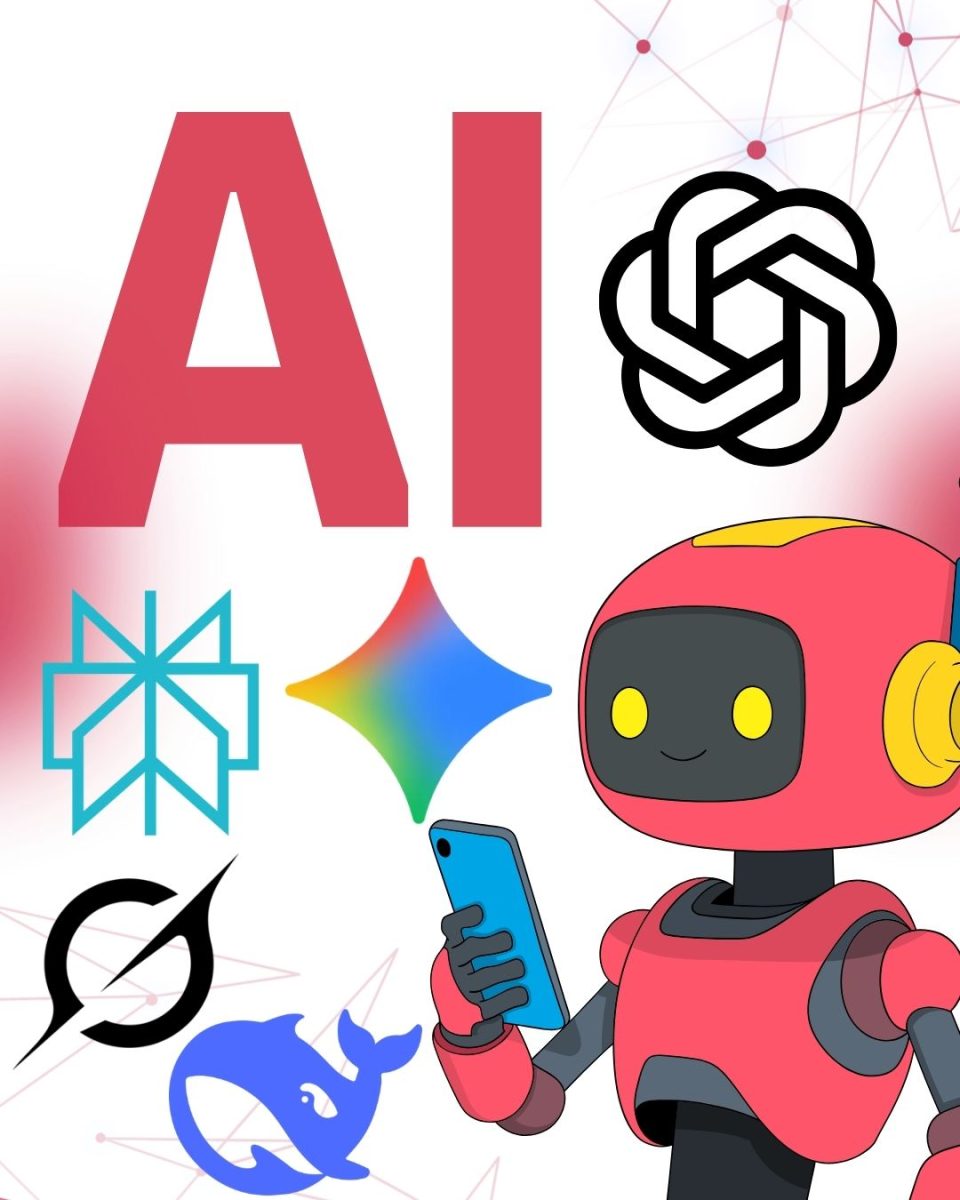
Imagine you spend hours brainstorming, writing, and editing an essay, all for your teacher to never actually read it. Instead, it was graded by the thing all teachers tell you not to use: artificial intelligence.
As “tools” like ChatGPT become more widely used in schools, some teachers are catching the bug and using it to grade students’ work. While this may save time, allowing an algorithm to judge your students’ work destroys any trust that had been built and could result in inaccuracies.
According to “Schools’ Embrace of AI Connected to Increased Risks,” by the nonprofit Center for Democracy and Technology, 85% of teachers used AI in the 2024-25 school year. Whether a teacher uses AI to grade an assignment or make a new lesson plan, it takes away the thoughtfulness and the personal connection between teacher and student.
Using this kind of technology can also lead to reliance; once you use it, it’s hard to stop. It’s understandable for teachers to be lured by AI; they have up to 25 students in one class, at least four classes every day, depending on the school, and students waiting to hear about how they did on their last test.
Students resort to using AI when they feel stressed and have so many other assignments that they just want to get them done; teachers might feel the same way.
“It has just taken a load off of the little minute things that I have to do so that I can just focus on teaching the kids,” Kim Lepre, a seventh-grade English teacher in California, told NEAToday.
Teachers can become just as addicted to AI as students, using it to grade or lesson plan because of its efficiency. It reduces hours of planning, typing, and grading to just minutes of copying and pasting. AI creates a dependency, allowing teachers to bypass the grading process for the sake of time. This convenience can lead to dehumanized teaching and result in AI-generated slop, rather than thoughtfully designed lessons.
Teachers’ use of AI could also lead to students writing to fit the algorithm or even holding back due to privacy reasons. As AI companies have created chatbots and teaching assistance, many of them do not protect the students’ privacy, and when a teacher inputs a personal essay that the student thought was going to their teacher into AI to grade, laws could be broken.
The legal and ethical concerns of using AI to grade assignments are significant and are primarily governed by federal laws like the Family Educational Rights and Privacy Act (FERPA) and the Children’s Online Privacy Protection Act (COPPA).
FERPA protects the privacy of a student’s education records. AI tools that process student data must comply with requirements. FERPA requires that third-party service providers use student data only for the purposes for which it was disclosed.
AI as a grading tool cannot use student submissions to train its models, sell data to third parties, or use the information for any purpose beyond providing the contracted grading service. AI is moving at breakneck speed, and without clear policies and guidelines from the district, it is unclear what is acceptable or not.
The draw to AI is that it promises efficiency, but education was never meant to be efficient at the expense of human understanding. When grading is handed over to algorithms, students quickly notice, and many begin writing for the machine rather than expressing their real ideas. When one adds the growing concerns about students’ privacy, the risks start to outweigh the rewards.
Administrators are cracking down on preventing students from using AI, rightfully so, but what about the teachers? There is a double standard here that needs to be fixed. Policies need to be put in place for everyone at PHS.

![Piscataqua River Bridge [I-95] taken, March 24, 2026, in South Eliot, Maine.](https://phspaperclip.net/wp-content/uploads/2026/04/A5094948-30A6-485A-AF79-7DE27D521913_1_105_c.jpeg)